
Factors Affecting the Overall Anti-Seepage Performance of HDPE Geomembranes — Welding Quality
5/27/20252 min read
I. Material Properties of HDPE Geomembranes
As a high-performance anti-seepage material, high-density polyethylene (HDPE) geomembranes are widely used in various anti-seepage projects due to their excellent anti-permeability, chemical corrosion resistance, high mechanical strength and anti-aging properties. HDPE geomembranes can not only effectively prevent the penetration of liquids and gases, but also maintain long-term stability in complex geological environments, thus playing an irreplaceable role in anti-seepage projects.
II. Welding Quality of HDPE Geomembranes
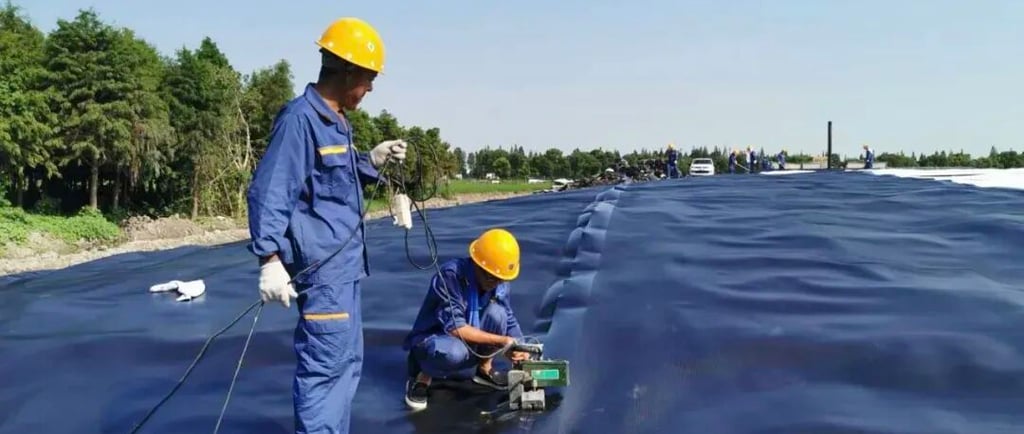
However, the anti-seepage effect of HDPE geomembranes depends not only on the performance of the material itself, but also closely on its welding and installation quality. Welding is a key link in the construction of HDPE geomembranes, and the welding quality directly affects the overall anti-seepage performance of the geomembranes. Therefore, the welding quality must be tested after the geomembranes are spliced and welded.
III. Testing Methods for Welding Quality of HDPE Geomembranes
Common testing methods include visual inspection, weld destructive testing and weld non-destructive testing.
① Visual inspection is a visual evaluation of the welding quality of geomembranes, which is a relatively rough judgment method;
② Destructive testing tests the strength of geomembrane samples in the welding area through shear and/or tensile tests, and the test results can feedback and guide the setting of relevant welding forms and parameters;
③ Non-destructive testing includes vacuum testing for extrusion welding, spark testing and air pressure testing for hot-melt welding, which can effectively detect the welding quality of geomembranes.
IV. Requirements for Controlling Welding Quality Parameters of HDPE Geomembranes
The control of welding parameters is the key to ensuring the welding quality of HDPE geomembranes. During the welding process, the control of parameters such as temperature, speed and pressure directly affects the compactness and strength of the weld.
Generally, the welding temperature is controlled at 350~400℃; the welding speed is controlled at 1~2m/min (double-seam heat sealing welding) or 0.5~1m/min (single-seam extrusion welding).
When hot-melt welding is adopted, the air pressure testing equipment is used to pressurize the weld air cavity to 250kPa and maintain it for 3min~5min. The air pressure should not be lower than 240kPa. Then, open a hole at the other end of the weld to release air. If the pointer of the barometer can return to zero quickly, it shall be regarded as qualified;
When extrusion welding is adopted, the vacuum testing equipment is used to directly apply negative pressure to the part to be tested of the weld. When the air pressure in the vacuum cover reaches 25kPa~35kPa and there is no leakage in the weld, it shall be regarded as qualified.
V. Relevant Standard Testing Requirements
According to the "Technical Standard for Anti-Seepage System Engineering of Sanitary Landfills for Domestic Waste" GB/T51403-2021 and the "Technical Code for Anti-Seepage System Engineering of Sanitary Landfills for Domestic Waste" CJJ113-2007:
a. Air pressure testing shall be carried out for each hot-melt weld, and the qualification rate shall be 100%;
b. Vacuum testing shall be carried out for each extrusion weld, and the qualification rate shall be 100%;
c. For weld destructive testing, take one 1000mm×350mm sample for strength testing for every 1000m of weld, and the qualification rate shall be 100%.
Contact
Reach out for inquiries or support
Phone
Will@longxingeosyn.com
+86 18663453889【WhatsApp】
© 2025. All rights reserved.
ADD No. 8, Canglongquan Street, Laicheng District, Laiwu City, Shandong Province, China
+86 18663461858【WhatsApp】
+86 18663463618【WhatsApp】
longxin@longxingeosyn.com
info@longxingeosyn.com