
All Your Questions About Geogrids, Answered in This Article
1/8/20254 min read
I. Basic Cognitive Questions (Must-Read for Beginners to Grasp the Core)
1. Q: What exactly is a geogrid? Is there any difference between it and ordinary mesh cloth?
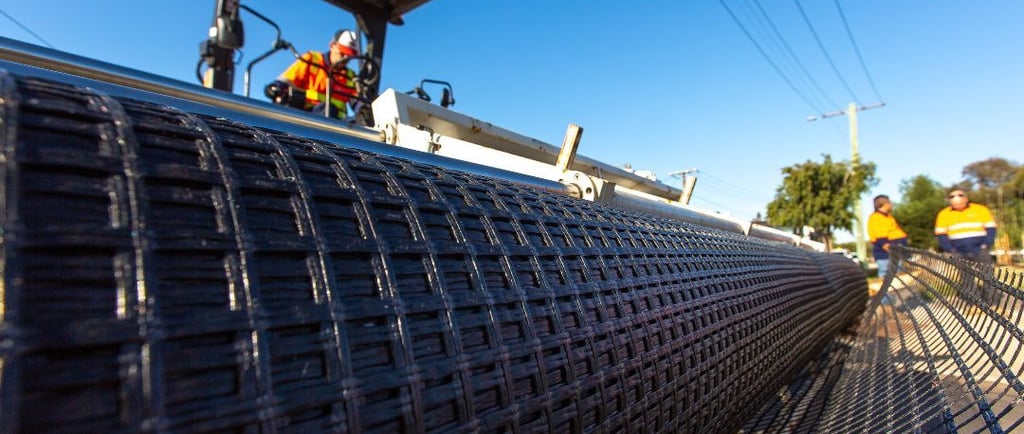
A: There is an essential difference! Geogrids are mesh-structured materials made of high-molecular polymers, glass fiber, etc., through special processes. Their core function is engineering reinforcement, with high tensile strength, anti-aging and corrosion resistance. Ordinary mesh cloth has a simple production process, low tensile strength, and can only be used for thermal insulation and protection, not for engineering reinforcement.
2. Q: What is the core function of geogrids? Where are they mainly used?
A: The core functions are reinforcement, anti-cracking and anti-reflection, isolation and stratification, anti-seepage and anti-scouring. Simply put, it is to "add bones and muscles to the project" to prevent subgrade settlement, pavement cracking and slope landslide. They are mainly used in various civil engineering projects such as highways, railways, water conservancy, municipal administration, photovoltaic power stations and rural infrastructure.
3. Q: What are the common materials of geogrids? What are the core characteristics of each material?
A: There are 4 main materials with clear characteristics, just remember them:
Plastic Geogrid: High cost performance, convenient construction, most widely used, suitable for ordinary scenarios;
Glass Fiber Geogrid: High tensile strength, low elongation, high temperature resistance, specially used for pavement anti-cracking;
Steel-Plastic Geogrid: High strength, strong corrosion resistance, suitable for heavy load and complex environments;
Polyester Geogrid: Good flexibility, suitable for soft soil foundation treatment.
4. Q: Are geogrids disposable products? Can they be recycled and reused after use?
A: No, they are not disposable products. High-quality geogrids can have a service life of 50-100 years and can be used for a long time when buried underground. Some plastic and polyester geogrids can be recycled and reused after being discarded, which conforms to the concept of green environmental protection. Glass fiber and steel-plastic geogrids are more difficult to recycle and are mostly used for temporary secondary reinforcement projects.
5. Q: Geogrids are very light in weight. Can they really play a reinforcing role?
A: Yes! Although they are light, high-quality geogrids have tensile strength comparable to mild steel (for example, steel-plastic geogrids can have a tensile strength of more than 300kN/m). Their core is to interlock and engage with soil through the mesh structure to disperse loads and restrict deformation. They do not bear weight by their own weight, but play a role through "active reinforcement".
6. Q: What is the difference between geogrids, geotextiles and geomembranes? Can they be used interchangeably?
A: They cannot be used interchangeably, as the three have different functions:
Geogrids: Core function is reinforcement, focusing on improving project stability;
Geotextiles: Core function is filtration and drainage, focusing on separating soil and preventing clogging;
Geomembranes: Core function is anti-seepage and waterproofing, focusing on blocking water seepage channels.
In actual projects, the three are often used together. For example, in water conservancy dikes, geogrids are used for reinforcement, geomembranes for anti-seepage, and geotextiles for filtration.
II. Purchase Questions (Must-Read for Procurement to Avoid Traps)
7. Q: When purchasing geogrids, which parameters should be prioritized?
A: 3 core parameters are indispensable: ① Tensile strength (determines the reinforcement effect); ② Elongation (the lower it is, the stronger the anti-deformation ability); ③ Anti-aging performance (determines the service life). Then, match the material and specification according to the engineering scenario.
8. Q: Can low-priced geogrids be bought? How much lower than the market average is not acceptable?
A: Not recommended! Most low-priced geogrids cut corners (reducing raw materials, not adding anti-aging additives), which are prone to aging and damage later, and the rework cost is far more than the price difference. Those lower than 30% of the market average should be directly rejected. Priority should be given to products from regular manufacturers with test reports.
9. Q: Is the third-party test report very important? How to distinguish the authenticity of the report?
A: Very important! The test report is the only certificate of product quality. Products without reports or with incomplete reports must not be bought. To distinguish authenticity: check whether the testing institution is qualified, whether the report has an official seal, and whether the core parameters (tensile strength, elongation) are clear. You can log on to the official website of the testing institution to query the report number.
10. Q: How to choose between unidirectional and bidirectional geogrids?
A: It depends on the force direction: ① Unidirectional geogrids: Strong force along a single direction (such as subgrade longitudinal direction, slope vertical direction), suitable for slope protection and retaining wall reinforcement; ② Bidirectional geogrids: Uniform force in both longitudinal and transverse directions, suitable for large-area bearing scenarios such as soft foundation treatment, pavement and squares.
11. Q: For different projects, what tensile strength of geogrids is suitable?
A: Choose according to needs, no need to blindly pursue high strength:
Rural roads and small-scale projects: ≥60-80kN/m;
Expressways and first-class highways: ≥120-150kN/m;
Heavy-haul railways, high slopes and deep-sea dikes: ≥200kN/m or more.
12. Q: When purchasing, what width and length of geogrids are suitable?
A: Common specifications: Width 2-4m (3m is the most commonly used, reducing lap joints and improving construction efficiency), length 50-100m (choose according to the project scale to avoid waste); mesh size is commonly 20-50mm, which can be adjusted according to the soil particle size.
13. Q: Is there any difference in purchasing geogrids for outdoor and indoor projects?
A: Yes! For outdoor projects (highways, slopes, photovoltaic), geogrids added with anti-aging and anti-ultraviolet additives should be selected, with a service life of ≥50 years; for indoor projects (underground garages, tunnels), the requirement for anti-aging is slightly lower, and ordinary plastic or polyester geogrids can be selected, focusing on tensile strength.
Contact
Reach out for inquiries or support
Phone
Will@longxingeosyn.com
+86 18663453889【WhatsApp】
© 2025. All rights reserved.
ADD No. 8, Canglongquan Street, Laicheng District, Laiwu City, Shandong Province, China
+86 18663461858【WhatsApp】
+86 18663463618【WhatsApp】
longxin@longxingeosyn.com
info@longxingeosyn.com