
A Brief Discussion on Geomembrane Anti-seepage Technology for Reservoirs of Pumped Storage Power Stations
1/1/20263 min read
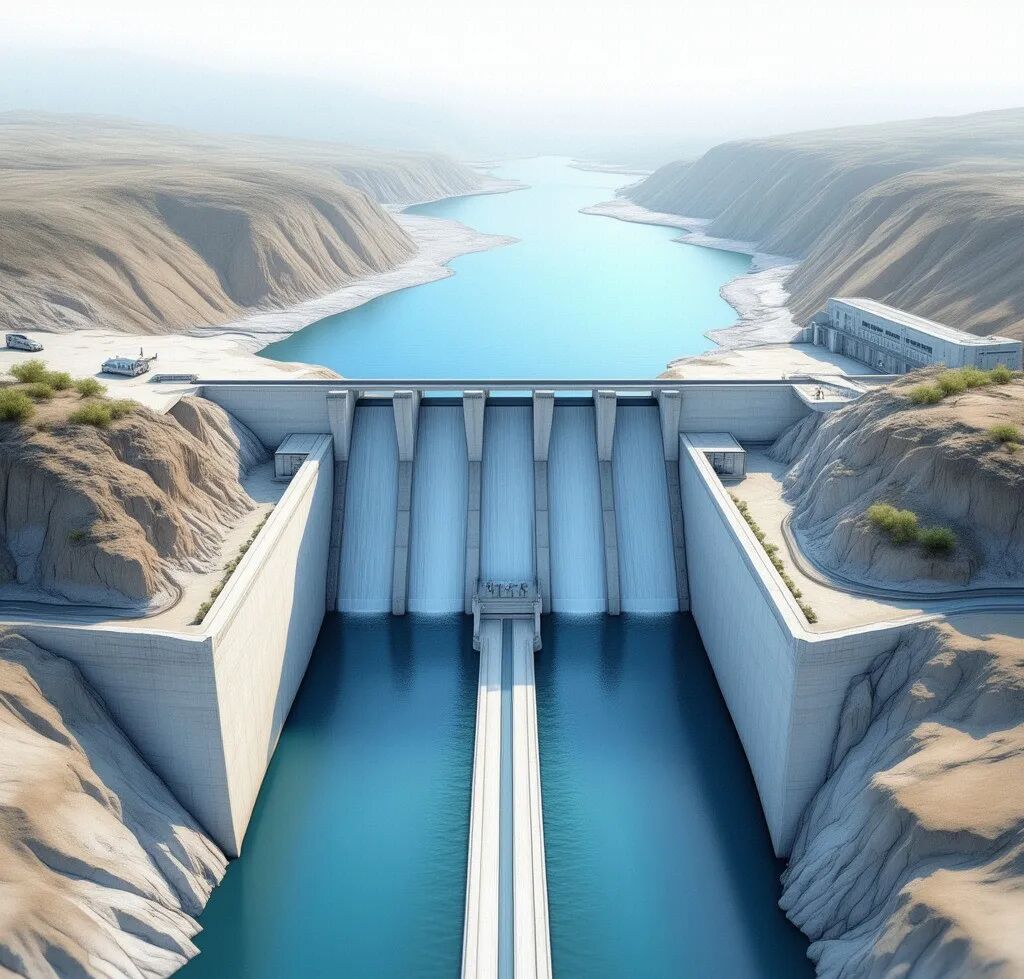
In the construction of pumped storage power stations, upper reservoirs often face severe anti-seepage challenges due to complex geological conditions (such as full reservoir basin filling, strongly weathered rock mass) or environmental protection requirements.
Compared with traditional concrete face slabs or asphalt concrete, geomembrane anti-seepage technology has become a key means to solve reservoir basin leakage problems, thanks to its excellent flexibility, extremely low permeability coefficient (up to 10⁻¹³ cm/s) and economy.
I. Core Selection: The Dominant Position of HDPE Membrane
Pumped storage power stations operate with high water heads and frequent sudden water level changes, which place extremely strict requirements on the mechanical properties and durability of membrane materials. At present, high-density polyethylene (HDPE) geomembrane is mainly adopted, with a thickness usually ranging from 1.5mm to 2.0mm. Its advantages are as follows:
High Strength and Puncture Resistance: Low yield elongation and high tensile strength, able to resist the long-term jacking of backfill gravel at the bottom of the reservoir.
Environmental Stress Crack Resistance: Adapts to the deformation caused by uneven settlement of the reservoir bottom, avoiding brittle damage.
Anti-aging: Adding additives such as carbon black to resist ultraviolet rays and high-low temperature cycles.
In special environments (such as seawater medium or requiring high flexibility connection), EPDM (ethylene propylene diene monomer) or TPO (thermoplastic polyolefin) membranes are also selected.
II. Structural Design of Anti-seepage System
Geomembrane does not work independently, but serves as the core layer of a "sandwich" structure. The typical structure from bottom to top is:
Support Layer: Gravel cushion (40~60cm thick) or geosynthetic mat, requiring flatness and compaction, with strictly controlled particle size to prevent the membrane from being punctured.
Drainage Layer: Three-dimensional composite drainage network, whose core function is to guide and discharge accumulated air and water under the membrane. If air pressure or water pressure accumulates under the membrane, it is very easy to lift and tear the membrane when the reservoir water level drops suddenly.
Anti-seepage Layer: HDPE geomembrane.
Protection Layer: Non-woven geotextile (buffer) + precast concrete blocks (ballast, 10~30cm thick), to resist water scouring, ice heaving and man-made damage.
III. Key Technical Nodes
1. Anchoring and Connection
The connection between geomembrane and concrete face slabs, water inlets/outlets or corridors is the "lifeline" of the anti-seepage system. Usually, pre-embedded locks + extrusion welding or concrete backfilling of anchoring trenches are adopted. The design shall reserve sufficient slack to absorb the differential settlement between the concrete structure and the filling body.
2. Welding and Inspection
Weld quality directly determines success or failure. Double-track hot-melt welding (lap width ≥10cm) is mainly used, and extrusion welding is used for T-joints and repairs. Quality control adopts the "three-inspection system":
Visual Inspection: The weld is flat and free of missing points.
Air Pressure Test: Pressurize the cavity in the middle of the double weld and maintain pressure to check airtightness.
Spark Test: Conduct a comprehensive scan of the membrane during operation or after laying to locate damage points.
IV. Key Construction Control Points
Laying Sequence: Follow the principle of "bottom first, then slope; center first, then surrounding" to avoid machinery walking on the laid membrane.
Environmental Control: Welding is strictly prohibited on rainy or windy days; preheating measures shall be taken when the temperature is lower than 5℃.
Finished Product Protection: Minimize the interval between laying and covering the protection layer to prevent ultraviolet aging and man-made damage.
V. Engineering Practice and Prospect
The successful application of large-scale pumped storage power stations in Liyang, Tai'an, Jurong and other domestic areas has proved that the leakage of the HDPE geomembrane anti-seepage system can be controlled within 20~30 L/s, which fully meets the operation requirements. With the promotion of new materials such as TPO and intelligent non-destructive testing technology, this technology will play a greater role in the construction of power stations under complex geological conditions.
Contact
Reach out for inquiries or support
Phone
Will@longxingeosyn.com
+86 18663453889【WhatsApp】
© 2025. All rights reserved.
ADD No. 8, Canglongquan Street, Laicheng District, Laiwu City, Shandong Province, China
+86 18663461858【WhatsApp】
+86 18663463618【WhatsApp】
longxin@longxingeosyn.com
info@longxingeosyn.com